
Letitia DeVillar Richardson
May 15, 2026
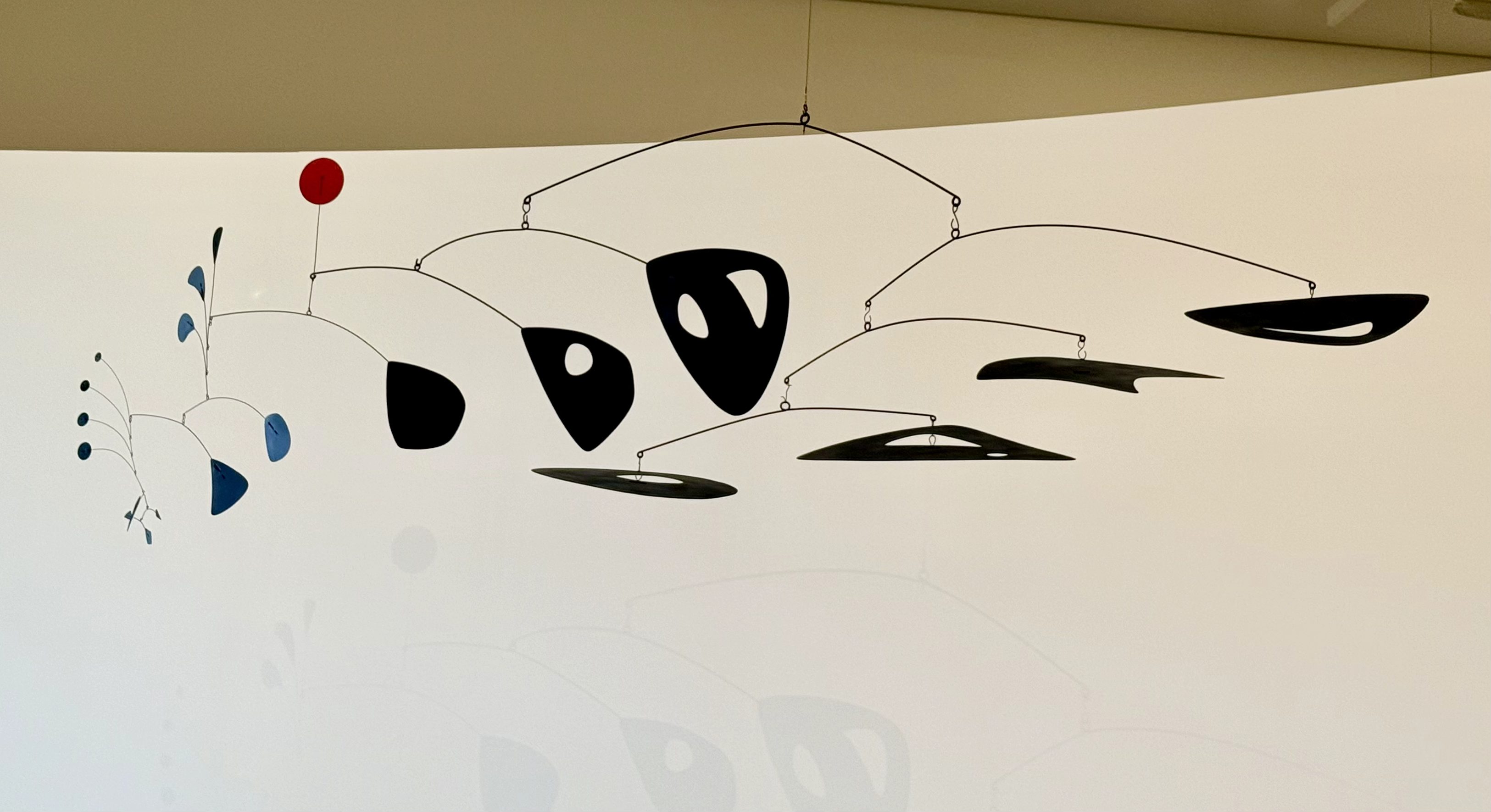
Alexander Calder (1898-1976), born in Lawnton, Pennsylvania, became one of the most celebrated sculptors of the 20th century. Venerated both at home and abroad, his work was the subject of an impressive retrospective entitled “Rêver en Équilibre” (Dreaming in Equilibrium) mounted by the Fondation Louis Vuitton (FLV) to celebrate the 100th anniversary of Calder’s arrival in Paris to study art.
This was the second retrospective I’d seen at the FLV, the first being last year’s David Hockney, and only this time did it dawn on me that the FLV must have been designed to showcase large retrospectives for artists with lengthy careers who left vast bodies of work. Designed by Frank Gehry and inaugurated in 2014, the building provides a magnificent backdrop for large-scale, bold works. Like the Hockney exhibit, the Calder retrospective did not disappoint.
Alexander Calder graduated from the Stevens Institute of Technology with a degree in Mechanical Engineering at the age of 21. He later explained that his parents, both trained in the arts, discouraged him from pursuing an artistic career due to the financial instability associated with that path. He also claimed he chose mechanical engineering because he knew a mechanical engineer and found him quite likable. Given the obvious importance of the geometric and physical principles which made his art possible, I suspect that this was said more tongue-in-cheek than otherwise.
Upon graduating, he worked for a time as an engineer but soon began to study art seriously at New York’s Art Students League, originally thinking that he would focus on oil painting. An early New York commission by the National Police Gazette required him to spend several weeks sketching the Ringling Brothers and Barnum & Bailey Circus. These sketches formed the basis for his beloved Circus Series paintings and eventually his circus miniatures.
In 1926, Calder moved to Paris, a city where both his parents had lived and worked. There he developed friendships with Joan Miró, Piet Mondrian, Marcel Duchamp, and Man Ray. While there, Calder couldn’t shake his fascination with movement and mathematics, and soon drawing and painting gave way to wire sculptures, abstract and figurative metal sculptures, and ultimately, gravity-defying mobiles.
Mea culpa: having seen his Circus Series years ago, I made the regrettable decision to not photograph the many pieces shown at the FLV. My apologies for that. If you like Calder’s work, you should explore the series further on your own. The complete series lives at the Whitney Museum of American Art in New York City.
Enjoy!
The following images present the type of oil paintings that Calder produced early in his career.

Todd Shipyard, 1925

Fourteenth Street, 1925
Soon Calder began to produce work that married his love for art with his genuine fascination with geometry and physics. The first hint of the direction Calder’s work would take is seen in the circus painting below where he exposes the vast space, from the big top’s structure to the relationships between the rigging, the tent poles, the ring, and the public.

The Flying Trapeze, 1925
He then put his oils aside and began working with wire sculptures. In the images below, we can appreciate how Calder progressively injected both lightness and movement into his sculptures. In the first piece, the figures feel overly detailed and heavy. In the second, he has lightened the figures by removing extraneous detail, but the magic has yet to appear. In the third piece, representing a typical circus human tower, Calder has managed to create a graceful, balanced sculpture with great dimensionality and movement. (Please note that I could not eliminate the shadows in these images. I thought they were worth including anyway. Just try to ignore the lighter shadow parts.)

Wire Sculpture by Calder, 1928

Hi! C. 1928

The Brass Family, 1929
I included the iconic Josephine Baker piece below not only because of Josephine’s cultural relevance (a black woman from the U.S. who fled Jim Crow repression and achieved recognition and acclaim as an artist, performer, civil rights activist, and French resistance fighter in Paris) but also because the piece speaks to Calder’s often playful eye and sense of fun. (Again, try to ignore the shadows.)

Josephine Baker IV, c. 1928
Below is the one image I took of the Cirque Calder. Like the other pieces in the series, it was made of common objects such as wire, cloth, yarn, painted metal, wood, leather, and string. All the miniature pieces in the series could be packed into suitcases and brought to life with movement and sound. It really is worth trying to see the entire series if you can (consider it a bucket list item!)

The Lion Tamer, 1926-1931.
In October of 1930, four years into his Paris experience, Calder visited Piet Mondrian’s studio whose walls were covered with movable rectangles of painted cardboard that served as interchangeable puzzle pieces from which Mondrian could finalize his groundbreaking geometric arrangements before committing paint to canvas. Calder took two ideas away from those movable templates and the resulting paintings: first, that he should simplify his imagery to clean geometric shapes, and second, that sculptures would be more impactful if they could move in space. From these two ideas, the Calder mobiles (a termed coined for Calder by Marcel Duchamp) would evolve. While his first geometric sculptures were static, later sculptures could be manually or mechanically manipulated. Eventually, Calder’s understanding of engineering principles would allow his perfectly balanced mobiles to move on mere gusts of air.

Object with Red Discs, 1931

Untitled, c. 1932

Untitled, 1933

Blue Panel, 1936
After returning to the U.S. in 1933, Calder travelled to Paris again in 1937 to attend the International Exposition. Visiting the Pavilion of the Spanish Republic with his friend Joan Miró, Calder met the Pavilion’s architects, Josep Lluis Sert and Luis Lacasa. The architects envisioned the Pavilion as an opportunity to show the world the desperation of the democratically elected Spanish Republic in the face of Fascist aggression. They planned an installation which would include Pablo Picasso’s painting of Guernica, the Spanish town bombed by German and Italian forces in support of Spanish Fascists, and a metal fountain representing the Almadén Mine, a stronghold of worker resistance to the Fascists. Calder had submitted a proposal for the fountain, but the submission was rejected as only Spanish artistic contributions were planned for the Pavilion. Nonetheless, when Sert and Lacasa were underwhelmed by the Spanish submissions, Calder reiterated his proposal. The architects accepted it, and the Mercury Fountain came to be. Using liquid mercury (the metal mined at Almadén) instead of water, Calder created a fountain of the shiny matter, which, striking a paddle below as it cascaded into the fountain’s basin, caused the entire red and black steel superstructure to oscillate. This piece can still be seen at the Fundación Joan Miró in Barcelona, although it is completely encased in glass due to the toxicity of the mercury. Only a scale model and a picture of a newspaper article appeared in the retrospective.

Mercury Fountain, scale model 1937

Newspaper image of Alexander Calder standing between Picasso’s Guernica and Calder’s own Mercury Fountain, 1937
In the following images, we can see how Calder’s explorations of weight, balance, color, and complexity led him ever closer to his iconic mobiles.

Four Leaves and Three Petals, 1939

Black Beast, 1940

Peacock, 1941

Laocoön, 1947
Following are several random images of Calder pieces that demonstrate his creative range, keen eye, and sense of humor. I was particularly surprised to discover that he designed jewelry, including a wedding ring for his wife (which she apparently gently declined). In the end, Alexander Calder was an artist whose work leaves little doubt as to his brilliance, his craftsmanship, and his unique contribution to our cultural landscape. The exhibit and the experience of writing about it put a smile on my face at every turn. I hope this post does the same for you.


Wedding Ring, 1930
Leave a Reply