
After our night without luggage, we got an early start and set out for Arzacq-Arraziguet. The walk was uneventful, with few notable sights along the way. We arrived in Arzacq-Arraziguet in time for lunch.

Arzacq-Arraziguet main plaza looking left.
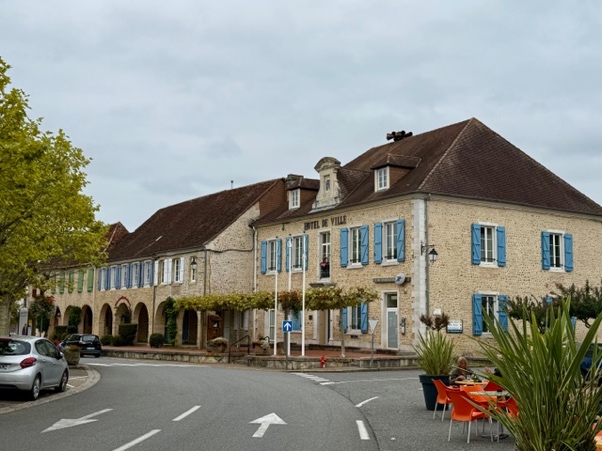
Arzacq-Arraziguet main plaza looking right.

Arzacq-Arraziguet private oasis.
In Arzacq-Arraziguet, we stayed at the former Maison d’Antan, now known as Chez Roxanne. It’s a bit of a sad story. The house and restaurant were run for many years by a beloved couple, Jean-Pierre and Roxanne Guerin-Recoussine. Jean-Pierre was a noted chef and had retired to this 4-room B&B in 2015 to experience a calmer life in the country (the population of Arzacq-Arraziguet is only 1,090). The couple made quite an impression with Jean-Pierre’s flamboyant personality keeping things lively and Roxanne’s kindly manner providing a steadying hand. Unfortunately, he passed away in 2022, leaving Roxanne to try and keep the hotel and restaurant running. It’s hard to step into the shoes of a master chef, but Roxanne is doing her best. Nonetheless, the condition of the place indicates a rough road ahead. The food, however, was top-notch. As vegetarians, we present the ultimate challenge to French sensibilities. Roxanne was up to the task, preparing an excellent meal including a cold Melon Soup, Potato and Onion Omelet, Ratatouille, and a Tarte Tatin, all perfectly executed and presented. As usual, we ate the main event before taking pictures -aargh!

Maison d’Antan aka Chez Roxanne.

An unusual church steeple along the route.

Picnic in Castillon on the way to Arthez-de-Béarn.
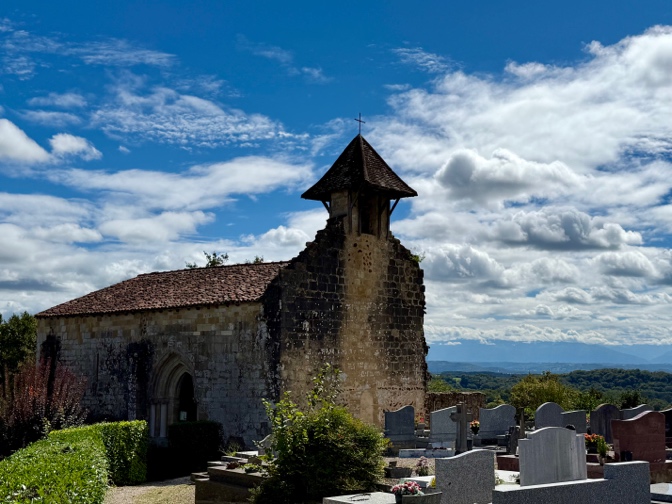
Chapelle de Caubin, a restored Romanesque chapel.

This goat found a comfy spot for sunning.
Arthez-de-Béarn:
In Arthez-de-Béarn we stayed at Domaine de la Carrère, a 16th or 17th century (evidence is mixed) gem right in the middle of town. The current owners, Jean-Pierre, a retired nuclear engineer and his soon-to-be retired wife, Véronique, purchased the estate from an art-loving couple who had thoughtfully renovated the property and filled it with European and Asian art. The resulting 4-bedroom B&B is really impressive, as can be seen in the photos below.

Domaine de la Carrère, welcoming front entry.

Family breakfast area and kitchen.

Dining room.
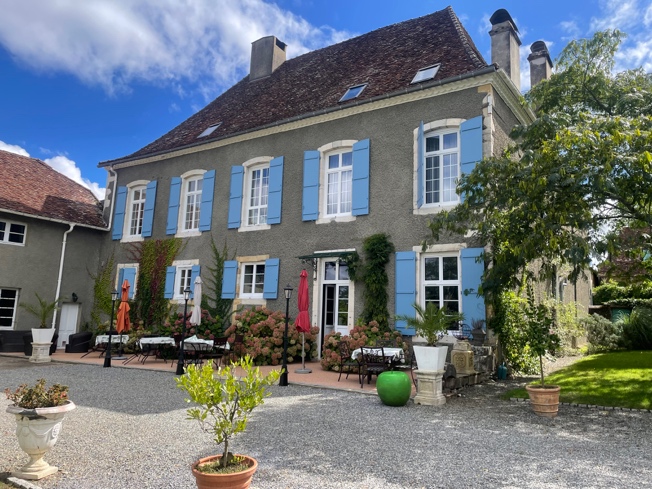
Back terrace.

Pool.

Stairs to second floor.

Our room on the second floor.

The breakfast spread with Véronique in the background.
Arthez-de-Béarn to Navarrenx:
The walk to Navarrenx was very challenging as this elevation image shows:

Quite obviously not to scale, it nonetheless highlights that we were not walking the fields of Kansas!
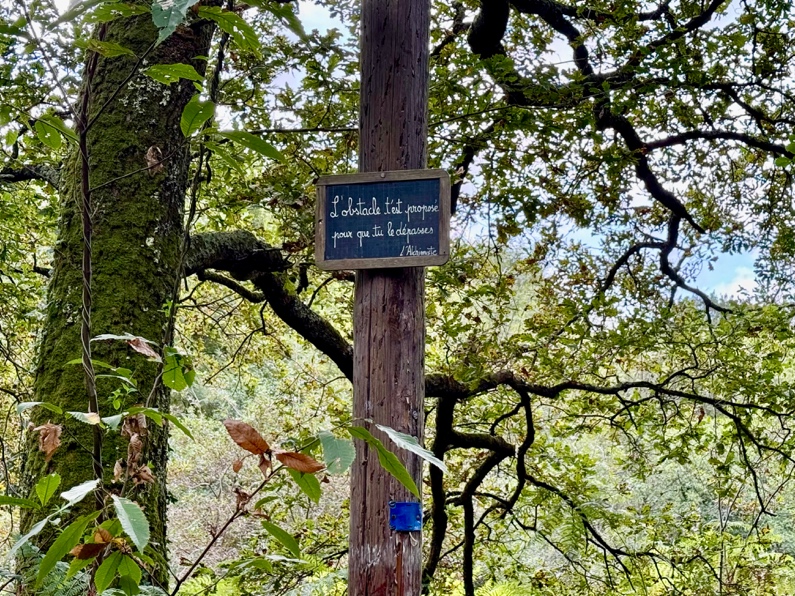
A helpful quote.
Along the way, a local resident posted a helpful quote from Paolo Coelho’s “The Alchemist”. “L’obstacle t’est propose pour que tu le dépasses” roughly translates to “obstacles are presented to you so that you may overcome them”. Sweet, but not necessarily helpful when you’re slogging up a seemingly endless climb on tired legs!
We were relieved to have a short reprieve in the town of Sauvelade, which despite its tranquil appearance, has a turbulent history.
A peak into the French Wars of Religion as Catholicism declined and Protestantism rose:

The church in the pretty town of Sauvelade.
The 12th century Sauvelade Abbey, dedicated to the Virgin Mary, and run by the Cisteaux order, exemplifies the architectural simplicity of the Catholic Cistercian Order. This simplicity reflected a desire to avoid superfluous ornamentation with the goal of enhancing the twin goals of contemplation and prayer.
Despite this patent call to spiritual purpose, many people felt that the Catholic clergy increasingly represented a corrupt and un-spiritual institution. Opponents began to follow the teachings of Protestant ministers who preached the austerity and purity of the earlier Catholic Church.
As support for the Catholic Church waned during the 14th century, the Sauvelade Abbey began its decline.
In the 16th century, the Protestant Queen Jeanne d’Albret of Navarre, seeking to further the spread of the Protestant faith, confronted Catherine de Médicis’ Catholic army in Béarn and burnt down the abbey.
After the French Revolution of 1789-1799, when all ecclesiastical property and fiefs were confiscated for the benefit of the nation, a wealthy citizen of the French Republic purchased the abbey and its outbuildings.
The church and its restored additions were listed as a historic monument in 1973, one survivor of the French Wars of Religion.
Navarrenx:
Navarrenx is a lovely, intact, walled town dating from the 10th century. It was the first French town to be fortified with Italian-style ramparts between 1542 and 1549, which protected the town during the Franch Wars of Religion. The town overlooks the Gave d’Oloron River. It was the home of the Queen of Navarre, Jeanne d’Albret, mentioned above. The Église Sainte-Germain, built in 1562, converted, along with the entire town, to Protestantism soon after its construction. In 1620, Jeanne’s grandson, Louis XIII wrested control of the area from Navarre and returned it to French control. He also restored Catholic worship to Navarrenx while preserving Protestant freedom of worship.

The walls of Navarrenx.

Leave a Reply