
(Centro de Arte de Escaldes-Engordany)
Andorra
The Centro de Arte de Escaldes-Engordany (CAEE) is a relatively small museum at the top of the pedestrian shopping mall that connects Andorra la Vella with Escaldes-Engordany. It’s three floors hold two permanent exhibits: one with a collection of models of churches and other Andorran structures and another with artwork by Catalan sculptor Josep Viladomat. The third floor houses three special exhibits per year, and we were lucky to visit “Albrecht Dürer, 70 works”.
Albrecht Dürer, German, 1471-1528, was a highly prolific and unabashedly modern artist. He defined art as a process that transcended established norms and sprang from the undying intellectual curiosity and innate talent of the trained artist. Conscious of his own talent and self-worth, he practically invented the marriage of marketing and intellectual property, moving art away from the pious production of religious imagery to the honor and repute of wealthier men, and toward a cult of the artist. This exhibit, drawn from the private collection of an avid Dürer collector, showcases Dürer’s engravings, etchings, and wood-block prints. The museum cleverly offers viewers magnifying glasses to better enjoy the incredible detail of Dürer’s work and/or enjoy a game of “Find the signature, a lesson in 15th century branding”. Okay, I made the game up, but I still had fun doing it. I thought I’d be at the museum for a hot 10 minutes (religious wood-block prints?) and ended up staying well over an hour. I’ve inserted several images below, and you can enjoy their meticulous rendering, immaculate perspective, and intricate assemblage, or just play “Find the signature” – no judgment. Hint: he didn’t always sign the work, his marketing efforts stopped short of annoying his patrons.
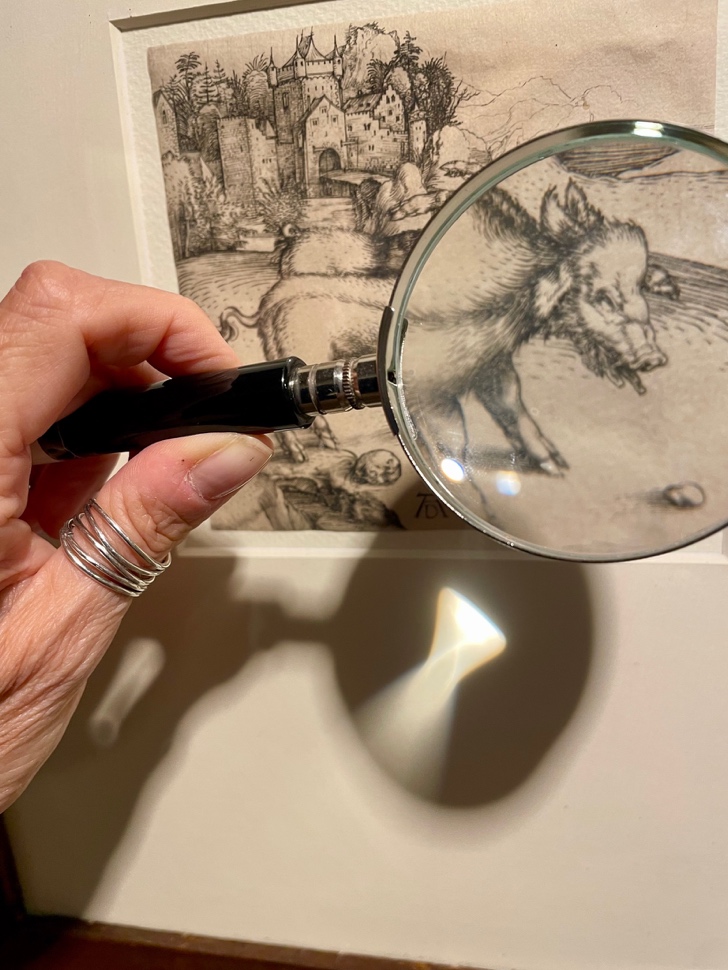
The Giant Pig, 1496.

Battle Between Hercules and Cacus, 1496.

The Men’s Baths, 1496.

The Martyrdom of Saint Catherine, 1498.

Saint Eustachian, 1501.

Shield and Skull, 1503.

The Nativity, 1504.

The Holy Family with Five Angels, c. 1503-1504.

The Big Horse, 1505.

The Adoration of the Three Kings, 1511.

Salomé presenting the head of John the Baptist to Herod, 1511.

The Holy Trinity, 1511.

Melancolica, 1514.
For the controversy around this piece see: https://www.google.com/search?q=What+is+the+controvery+behind+D%C3%BCrer%27s+Melancolica%3F&oq=What+is+the+controvery+behind+D%C3%BCrer%27s+Melancolica%3F&gs_lcrp=EgZjaHJvbWUyBggAEEUYOTIJCAEQIRgKGKABMgkIAhAhGAoYoAEyCQgDECEYChigATIJCAQQIRgKGKABMgcIBRAhGI8CMgcIBhAhGI8C0gEJMTU0ODJqMGo5qAIAsAIB&sourceid=chrome&ie=UTF-8
Josep Viladomat
A word about Josep Viladomat (1899-1989) and the Viladomat brand. Born in Catalunya at the turn of the century, the sculptor JosepViladomat earned early acclaim before his military service during the Spanish Civil War forced his exile to France in 1938 and later settlement in Andorra and Barcelona. He until the age of ninety, and his work underwent several phases with foci including the feminine ideal, the image behind the mirror, pain as manifested in sculpture, and religious “imaginary”. We had left little time for this section of the museum, so I’ll limit myself to sharing some images below, without specific commentary.
As we walked through Andorra, however, we often saw Viladomat stores, and, confident that the famous sculptor was not behind these, yet intrigued by the naming coincidence, I did a little research. It turns out that Josep’s talented children, Adelaida and Francesc, founded the brand in Andorra in 1951. Francesc, an avid skier and competitor in the 1952 and 1956 Winter Olympics is also responsible for putting Andorra on the ski world map. He installed the first ski lift on Coll Blanc in Pas de la Casa in 1956. Powered by a lorry engine, the lift could transport up to 450 skiers per hour to the top of the mountain. Adding one new ski lift per year, Francesc ensured that generations of skiers would gravitate to Andorra. Between marketing Andorra as a ski destination, building the infrastructure to accommodate visiting ski aficionados, and developing a sports wear brand, the Viladomat children set the stage for a modern Andorra, an enduring legacy to their father’s genius.

Woman with a Scarf: Homage to Michaelangelo, 1966.

Fisherman from Hondarrabia, 1938

Sant Jordi, the Antifascist, 1945

Leave a Reply